
The Best Dog Gate for Pomeranians (That Doesn't Ruin Your Home)
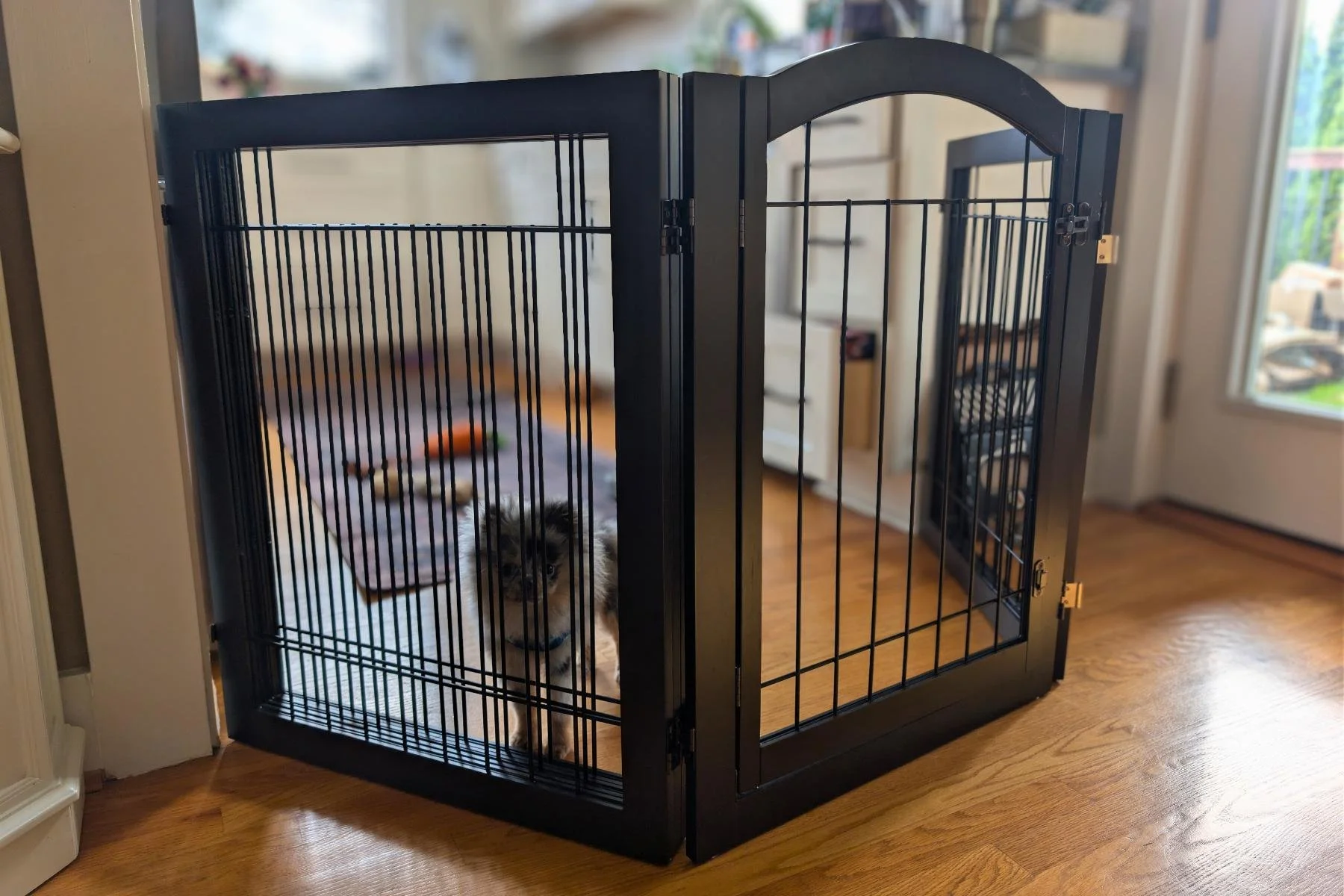
Quick answer: The best dog gate for Pomeranians is a freestanding configurable wood gate with vertical slats and a clean finish. It blocks doorways, shapes into a pen, folds up for storage, and doesn't look like a baby-proofing project gone wrong. We use ours daily to block the front door and contain the kitchen. In espresso brown, it disappears into the room.
The front door is the problem. You open it to grab a package, say hello to a neighbor, or step outside for thirty seconds, and a tiny Pomeranian sees an opportunity. They are fast, they are low to the ground, and they do not share your assessment of how long thirty seconds actually is.
A gate between the entryway and the rest of the house solves this immediately. We've had ours for months and the front door situation is no longer something we think about.
The harder part was finding a gate that actually worked in a real home. Not pressure-mounted against walls we didn't want damaged, not plastic and bright white, not a permanent installation. Freestanding, configurable, and something that looked intentional rather than desperate.
Some links in this post are affiliate links. If you purchase through them, I earn a commission at no extra cost to you. Everything recommended here is something we've personally used with Beignet and our Pom pack.
The Front Door Problem (and Why This Gate Solves It)
Pomeranians are confident in a way that is disproportionate to their size. Ours treats the gap between the open front door and the outside world as an invitation rather than a boundary. A standard pressure-mounted gate across a doorway didn’t work for our room configuration.
The freestanding gate is the answer. It stands on its own, shapes to the space, and doesn't require drilling or pressure tension against walls. We have ours angled across the entryway in a subtle U/V configuration that covers the opening without being mounted to anything. It takes about 45 seconds to reposition if we need it somewhere else.
On the Height: It's a Feature If Your Pom Jumps
We noted when we bought it that this gate runs taller than the standard options. Most dog gates are sized for dogs that don't jump. Pomeranians jump. Beignet can clear something that would contain a Labrador puppy without breaking stride.
The height means you can't treat it as something to step over casually. You open the latch, you pass through, you close it. That's the trade-off. But it also means the gate actually works for a dog who would otherwise sail over a shorter option, which is the entire purpose.
If your Pom is not a jumper, a shorter gate would be more convenient. If yours is — or if you're not sure yet — this size is perfect.
We like the gate height, but it’s not something you can step over. This is annoying for about three days and then you stop thinking about it. For a Pom who jumps, the height is the point.
The Second Job: Kitchen Containment
The front door is the primary use. The kitchen is the second one.
When we're separating the dogs at mealtimes, or when one of us is cooking and wants to keep an eye on the puppy without also managing Beignet underfoot, the gate goes across the kitchen entrance. It takes about twenty seconds to move from the entryway to the kitchen opening. It takes the same twenty seconds to move back.
This flexibility is the thing that makes a freestanding gate worth the trade-off in latch convenience. A mounted gate is in one place forever and you’re always adjusting it. This one is wherever it needs to be that day.
We've had it in at least four different configurations: straight across a doorway, angled V at the entryway, an L-shape in a corner to create a small contained zone, and a wide arc across an open-plan space. All of them worked without any tools or adjustment.
It's Heavy — That's the Point, but Read This First
The gate is solid. Noticeably heavier than most options in the same category. Our puppy has pushed against it, nudged it, and tested it with the particular persistence young dogs have for things they've been told are boundaries. It has not moved.
The weight is what makes it work. A lightweight freestanding gate on a hard floor will walk, tip, or get nosed aside by a determined dog. This one stays where you put it because it has the mass to hold its position without being anchored to anything.
That same weight is worth respecting during setup. Use the provided feet and make sure the gate is in a stable configuration before leaving it unattended. A heavy gate that tips is worse than a lightweight one. You do not want that falling on a small dog. Once it is properly set up and standing correctly, it is not going anywhere.
The practical upside: we have never had to chase it across the floor or reset it mid-day. It is where we put it. It stays.
Folds Flat for Cleaning
This sounds minor. It is not minor.
Dog hair migrates. It accumulates in corners, under furniture, and along the base of anything that sits on the floor for extended periods. A gate that lives in one place permanently becomes a fur-collection device that's annoying to clean around.
This gate folds completely flat. When we're cleaning, we fold it, lean it against a wall, vacuum the floor underneath, and put it back. The whole process adds maybe ninety seconds to the cleaning routine. For something that's out every day, that matters.
The Latch Situation
The gate ships with latches that you install yourself. This is the part that is mildly annoying. It's not complicated but it is an extra step that requires a few minutes and a screwdriver, rather than a gate that arrives ready to use.
We installed the top latch only and left the bottom one off. The top latch has been entirely secure for months. The puppy has not escaped through it. Beignet has not escaped through it. If you have a dog that actively works at gates — prying, pushing from the bottom — you might want both. For a Pom who is mostly deterred by the presence of a barrier rather than engineering around it, the top latch is sufficient.
It Doesn't Look Like a Baby Gate
This is the thing that's hard to communicate about most pet containment products: they look like pet containment products. Bright white plastic, primary-color accents, the general aesthetic of something you'd buy at a big-box store and hope no one notices.
This gate has clean vertical wood slats and an espresso finish. In a room with warm neutrals or dark wood tones, it reads like a design choice rather than a concession. It is not invisible — it's a gate — but it's the kind of thing guests notice without it registering as an eyesore.
For a home where the aesthetic matters as much as the function, that's not a small thing.
The Rest of the System
The gate handles containment. The things we've found matter just as much for keeping a Pom household feeling calm are what's happening at floor level and in the air. If you haven't looked at these yet: Best Vacuum for Pet Hair and Best Air Purifier for Pet Dander.
Both are written the same way as this — what we actually use, what we'd buy again, and our real experience living with three Pomeranians.
