
The Best Harness for Pomeranians (What Beignet Wears Every Day)
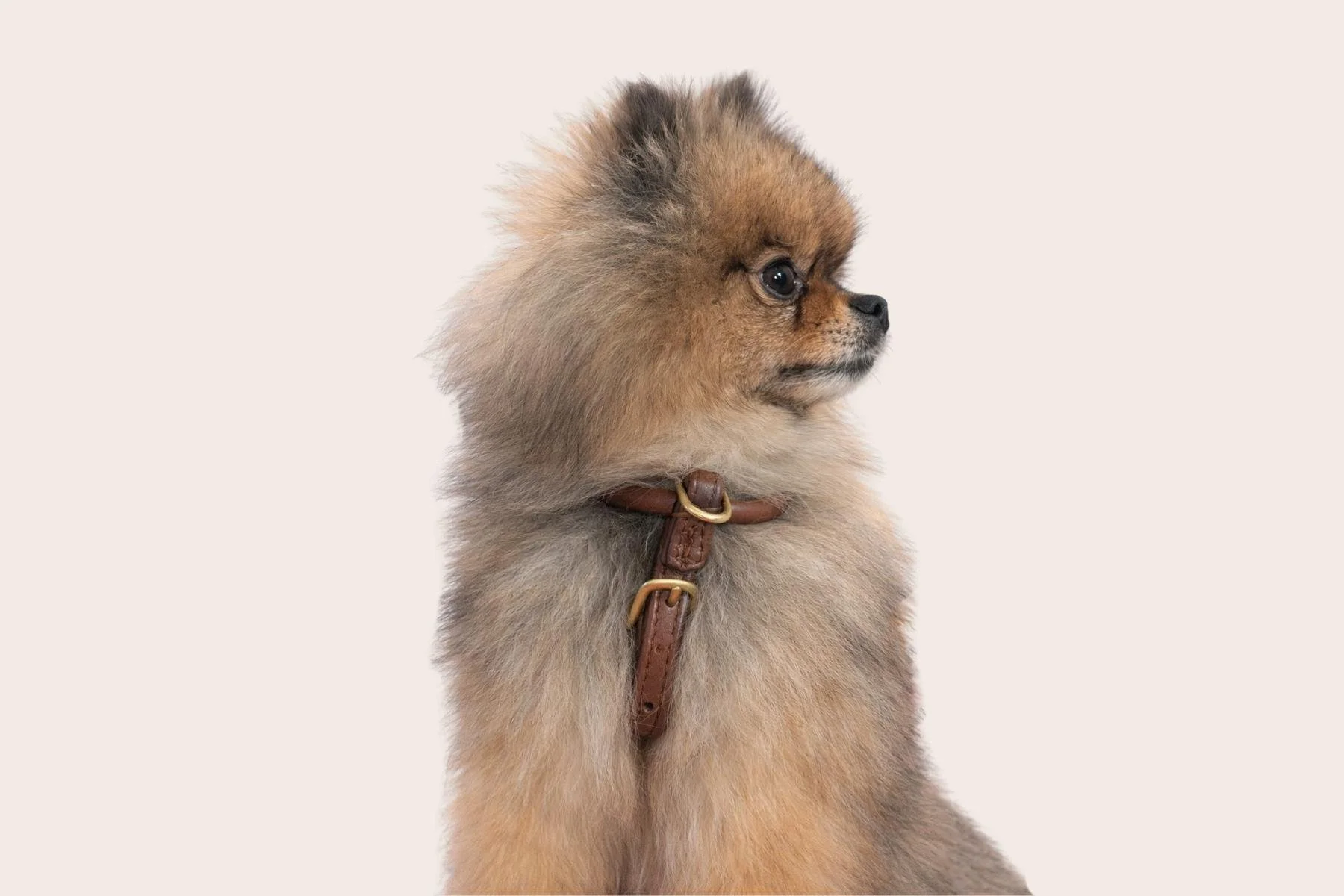
Quick answer: The best harness for Pomeranians is the Hund Denmark Cushioned Harness in rolled leather. It protects the coat from chest mats, keeps pressure off the trachea, fits so cleanly it disappears into a Pom's fur, and is built from European leather that improves with age. Beignet wears his daily. We'd buy it again without hesitation.
The honest origin story: we bought Beignet a gorgeous designer leather collar and then looked at his harness and felt embarrassed. The harness was fine. It was just visibly not in the same conversation as everything else we'd put thought into.
Pom leashes shouldn't attach to collars — the trachea risk for a small dog on any kind of lead tension is real and well-documented. So the collar was always going to be decorative. The harness was doing the actual job. Now it needed to look the part.
The Hund Denmark Cushioned Harness is what we found. We bought it years ago, and Beignet still wears it every day, takes it off only for grooming sessions, and has a GPS tracker clipped to it. It has become the small investment that paid off — the thing we don't think about because it just works.
Why Pomeranians Shouldn't Walk on a Collar
This is worth saying plainly because not everyone knows it going in. Pomeranians have delicate tracheas. A dog that pulls, lunges, or simply hits the end of the lead while attached at the neck is putting direct pressure on that structure. Over time, repeated collar pressure can contribute to tracheal collapse, which is exactly as unpleasant as it sounds.
A harness distributes lead pressure across the chest and shoulders instead. There's no neck involvement at all. For a dog Beignet's size — four pounds, confident, curious, occasionally convinced a bunny requires urgent intervention — this matters.
We kept the collar for identification tags and aesthetics. The leash attaches to the harness only. This is the setup we'd recommend to anyone with a Pom regardless of what harness they choose.
What Rolled Leather Does for a Pomeranian Coat
Most harnesses are made from flat nylon webbing. Flat webbing lies against the coat, creates friction, and, over time, mats the fur. On a Pom with a full double coat, chest mats are particularly frustrating: they're hidden under the outer layer, they grow quickly, and they're unpleasant to work out.
Rolled leather solves this structurally. The cylindrical profile means the harness contacts the coat at a narrow point rather than lying flat against it. It sits on top of the fur rather than compressing it. Beignet has been wearing his daily for months. His chest coat is intact.
This isn't a minor aesthetic detail — it's the functional reason rolled leather harnesses exist. If your Pom wears a harness regularly and you're finding chest mats, the harness material and profile are the first things to look at.
Sizing: Go True to Size or Slightly Down
We sized slightly up. We regret it.
The harness fits well enough that it's genuinely hard to see on Beignet. It nestles into his coat and disappears. But I think I underestimated the size of his fur when I measured, so it’s a tiny bit loose and shifts around. Not enough for him to get out of it, but enough that I have to reposition it before walks.
The Hund sizing guide is accurate. Trust it, or go a half-size down if you can’t get a great measurement because of your Pom’s floof.
One thing that earned real trust: the leather is substantial enough to punch your own adjustment holes if needed. We did this. It took a standard leather hole punch and thirty seconds. The leather didn't crack or tear.
The leather is European and visibly high quality. It will improve with age and use rather than degrading. This is not a harness you replace annually. It's closer to something you keep.
Built for All-Day Wear
Beignet wears this harness for essentially every waking hour. It comes off for grooming since line brushing and bathing require full coat access but it goes back on after. That's the routine.
He also carries a GPS tracker on it. The D-ring holds the tracker cleanly without the harness shifting or the tracker migrating. For anyone who uses a location tracker on their dog, the attachment point matters more than you'd think — a cheap harness with a flimsy ring becomes unreliable quickly. This one has not.
We haven't noticed any coat wear, pressure points, or signs of irritation from all-day use, and we’ve owned it for years. For a harness that's on more hours than it's off, that's the real test.
One Honest Limitation: No Quick Release
The Hund harness is not a quick-release design. Getting it on and off requires working the buckle in the conventional way. It's not a push-button situation.
For daily walks and home wear, this is a non-issue. For environments where the harness might need to come off quickly (a dog park, boarding, daycare, any situation where another person is managing your dog) it's worth knowing. We don't use Beignet's harness in those contexts for this reason.
If your Pom's life involves regular boarding or group play, factor this in. For a dog that's primarily home and on-leash walks, it won't come up.
It Looks Exactly as Good as It Should
The cognac leather reads as an accessory rather than equipment. Next to a quality collar, it belongs. Against a plain backdrop, it's the kind of thing people notice and ask about.
This matters more for some people than others. For us, it was the starting point — the existing harness looked wrong next to everything else. The Hund looks right and is designed to support our Pomeranian. Best of both worlds.
The Rest of the Routine
The harness handles the walk. The coat work that keeps a Pom looking right between walks is a different system. Start with how often to brush a Pomeranian and the best brush for a Pomeranian double coat. Both are written the same way as this — what we actually use, based on our real experience living with three Pomeranians.
