
How Often Should You Brush a Pomeranian? (Research-Backed Schedule)
Quick Answer
- Most adult Pomeranians need brushing 3–4 times per week
- Spot brushing daily can help keep mats at bay
- The right frequency depends less on how fluffy your dog looks and more on how their coat behaves between sessions
If you’ve ever wondered whether you’re brushing your Pomeranian too much, or not nearly enough, you’re not alone. Pomeranians have a dense double coat that looks fluffy on the surface but can mat quietly underneath if it isn’t maintained correctly.
That double coat includes a soft undercoat and longer guard hairs. If the undercoat isn’t separated regularly, it compacts near the skin, even when the surface looks brushed. That’s why brushing frequency alone doesn’t tell the whole story.
Let’s break it down.
The Ideal Brushing Schedule for Pomeranians
For most adult Pomeranians
3–4 full brushing sessions per week is the sweet spot.
This keeps:
Loose undercoat from compacting
Small tangles from turning into mats
Shedding manageable without overworking the coat
Each session doesn’t need to be long. Five focused minutes, done correctly, beats 20 rushed ones.
When daily brushing makes sense
Daily brushing isn’t required for every Pom, but it is helpful if:
Your dog is blowing coat seasonally
They wear a harness daily
They’re prone to friction mats behind the ears, chest, or legs
They recently had a bath and the coat is extra airy
In these cases, think of daily brushing as maintenance, not a full grooming routine. A quick pass to keep the coat separated is enough.
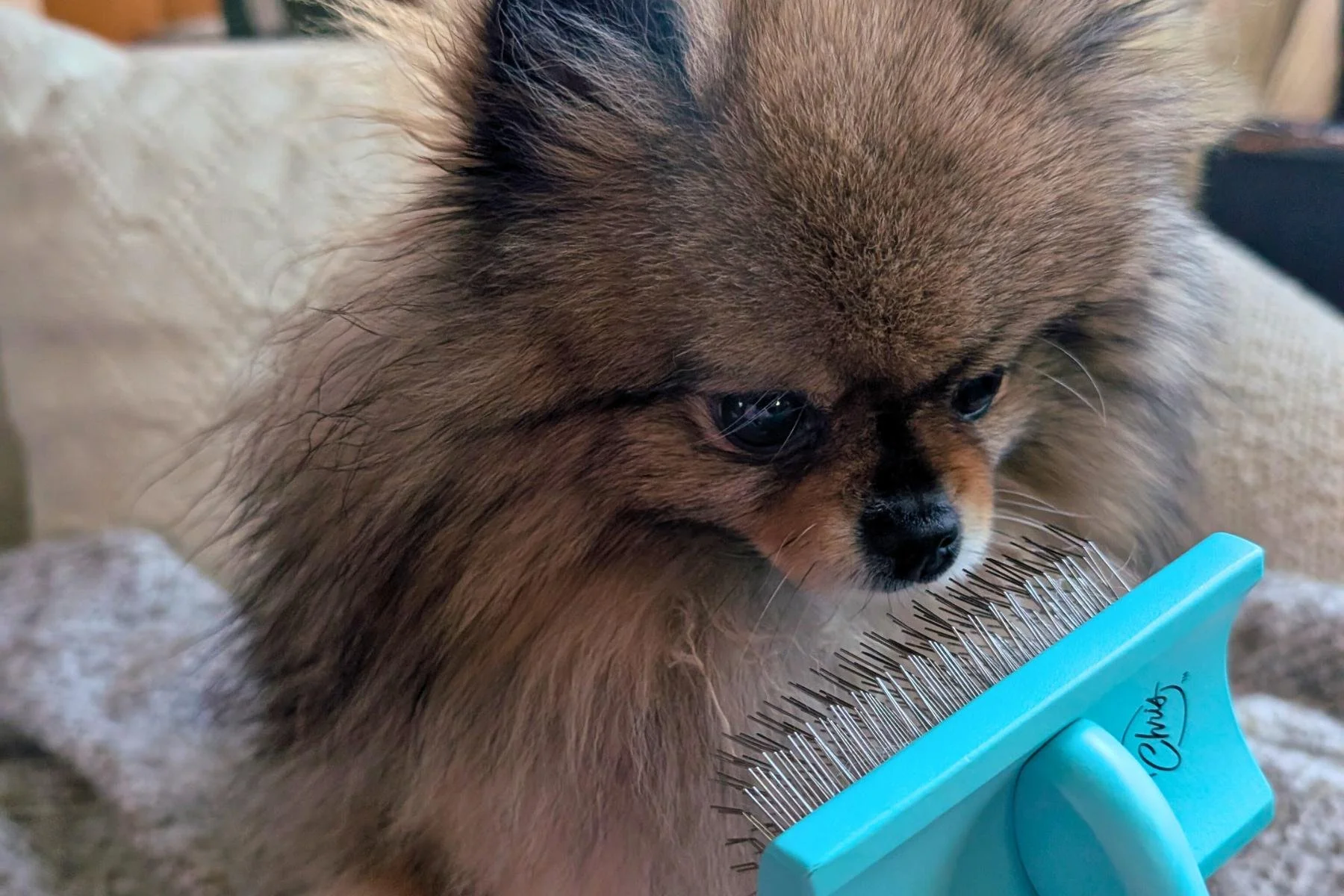
It's even easier when you use the right brush — the one we use on Beignet every morning.
Can You Over-Brush a Pomeranian?
Yes, but it’s less common than under-brushing.
Over-brushing usually happens when:
Brushing is done on a dry coat
Too much pressure is used
The wrong brush is used repeatedly in the same area
This can lead to breakage, dullness, or coat thinning over time.
The fix:
Always brush with light pressure and a slightly hydrated coat. A gentle conditioning mist makes brushing smoother and protects the hair shaft.
Why brushing technique matters more than frequency
Many owners brush often and still end up with mats. That’s because surface brushing doesn’t reach the undercoat, where problems start.
What matters:
Using a brush designed for dense double coats
Brushing in sections (not just skimming the top)
Following with a comb to check your work
If a comb doesn’t glide through easily, there’s still tangling underneath, no matter how fluffy the coat looks.
A simple, realistic routine that works
If you want a low-stress approach that fits real life, aim for this:
3–4 times per week:
A short, intentional brushing sessionDaily (optional):
30–60 second check of friction zonesAlways:
Brush gently, on a lightly conditioned coat
This keeps the coat healthy and prevents the kind of matting that leads to shaving later.
The tools matter more than the schedule
If brushing feels like it never “sticks,” it’s usually not you. It’s the tools.
Pomeranian coats need:
A brush that can reach through dense fur
A metal comb to confirm there are no hidden tangles
Light hydration to reduce friction
Using the wrong tools often leads people to brush more often than necessary, without better results.
→ Our recommended grooming tools for Pomeranians
For the rest of the home routine, here's how often to bathe and the vacuum we use for Pomeranian fur.
FAQ: Brushing Frequency for Pomeranians
-
Daily brushing isn’t automatically harmful, but it isn’t necessary for most adult Pomeranians.
Over-brushing becomes a problem when it’s done on a dry coat, with too much pressure, or with the wrong brush. For a dense double coat, 3–4 focused brushing sessions per week is usually enough, with quick daily checks during heavy shedding or friction-prone seasons.
-
Most sessions only need 5–10 focused minutes when done correctly.
The goal is complete separation of the undercoat, not extended surface brushing. If you’re line brushing in small sections and using light conditioning spray, shorter, methodical sessions are more effective than long, rushed ones.
-
Yes.
During seasonal coat blows, the soft undercoat releases more heavily. At that point, brushing may need to increase temporarily to prevent compaction near the skin. Short, frequent sessions help remove loose undercoat before it forms small mats.
-
Yes, and under-brushing is more common than over-brushing.
Because a Pomeranian’s double coat looks fluffy on the surface, hidden tangles near the skin can go unnoticed. If brushing is too infrequent, the undercoat compacts and mats can form quickly, especially behind the ears, under the harness area, and along friction zones.
-
Not necessarily.
Technique and tools matter more than frequency. A properly separated double coat, maintained consistently, stays healthier than one that’s brushed daily on the surface but never fully worked through. Quality beats quantity when it comes to coat care.
