
Slicker Brush vs Pin Brush for Pomeranians: Which One Reaches the Undercoat
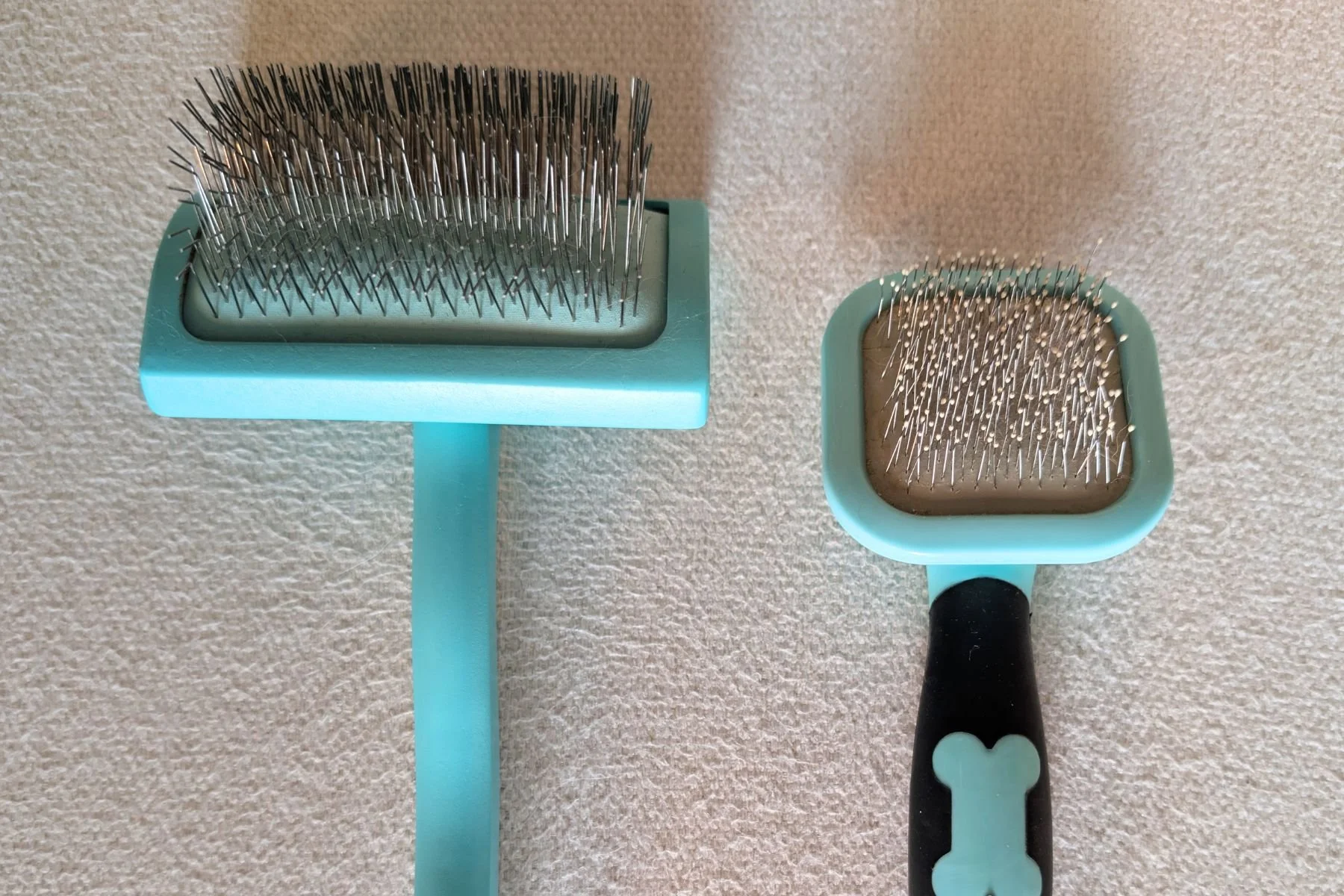
Long-pin slicker brush (left) and pin brush (right) compared for Pomeranian coat maintenance
Quick Answer
- For most adult Pomeranians, a long-pin slicker brush is the better primary tool
- A high-quality long-pin slicker prevents matting, reduces breakage, and makes line brushing effective
- A pin brush is better for puppies without double coats. It smooths the surface but rarely reaches the dense undercoat where mats actually form
Why Brush Type Matters for a Pomeranian
A Pomeranian’s coat has two layers:
A soft, compact undercoat
Longer outer guard hairs that create volume and shape
Surface brushing can make the coat look fluffy. But unless the undercoat is fully separated near the skin, matting can form quietly underneath.
That’s why choosing the right brush can make a difference in how your Pomeranian’s coat looks and feels.
What a Slicker Brush Does
A long-pin slicker brush is designed to move through both layers of a dense double coat.
When used with light conditioning spray and proper line brushing technique, a slicker brush:
Reaches the base of the coat
Separates compacted undercoat
Reduces hidden mat formation
Preserves outer guard hairs
The fine, angled pins lift and separate rather than skim across the surface.
For most adult Pomeranians with a full double coat, this is the tool that maintains a beautiful, fluffy coat long-term.
What a Pin Brush Does
A pin brush typically has straight pins with rounded tips set in a flexible cushion base.
Pin brushes are often used to:
Smooth the outer coat
Gently detangle surface hair
Finish styling after brushing
They are softer and more forgiving, but that softness limits how deeply they work.
On a dense Pomeranian double coat, a pin brush often:
Skims the surface
Misses compacted undercoat
Leaves small tangles untouched near the skin
The coat may look brushed, but the structural separation hasn’t happened. The mats and tangles are still there, hidden underneath the top fur.
Slicker Brush vs Pin Brush: Quick Comparison
| Feature | Slicker Brush | Pin Brush |
|---|---|---|
| Reaches undercoat | Yes | Rarely |
| Prevents matting | Yes | Limited |
| Best for adult double coat | Yes | No |
| Surface smoothing | Moderate | Yes |
| Good for puppies | With care | Yes |
| Price range | $45–$55 | $8–$20 |
Slicker Brush vs Pin Brush: The Practical Difference
For a Pomeranian with a full adult coat:
A slicker brush performs the structural work.
A pin brush performs cosmetic smoothing.
If you rely only on a pin brush, the undercoat may gradually compact over time, even if you are brushing consistently.
If you rely on a properly sized long-pin slicker brush, you can maintain separation, reduce friction, and keep sessions shorter and calmer.
When a Pin Brush Can Be Useful
A pin brush may be appropriate:
For very young puppies without a developed double coat
As a light finishing tool after slicker brushing
For quick surface smoothing between full sessions
But for maintenance of a dense double coat, it should not replace regular brushing.
Choosing the Right Tool for Your Pomeranian
If you are choosing one primary brush for a Pomeranian, a long-pin slicker brush is typically the most effective tool.
It supports proper line brushing, reaches the undercoat, and helps prevent hidden matting before it starts.
If you’d like a full breakdown of the specific slicker brush we use, and why pin length matters for double coats, read our full breakdown of the best slicker brush for Pomeranians.
Final Thoughts
Pin brushes are not “bad.” They’re simply limited.
For a breed with a dense double coat like the Pomeranian, maintaining the undercoat matters more than surface smoothing.
When the undercoat gets a proper brushing, the coat stays fuller, healthier, and easier to maintain over time.
→ See our full list of recommended grooming tools to maintain a Pomeranian’s double coat
FAQ: Slicker Brush vs Pin Brush for Pomeranians
-
Yes, but usually as a secondary tool.
A pin brush can smooth the outer coat and lightly detangle surface hair. However, on a dense double coat, it typically does not fully separate the undercoat near the skin. For coat grooming, a slicker brush is usually more effective.
-
Yes, when used gently and with light conditioning spray.
A properly sized long-pin slicker brush can safely separate the undercoat without damaging the outer guard hairs. Pressure and technique matter more than the tool itself.
-
Not necessarily.
Most Pomeranian owners can maintain the coat with a long-pin slicker brush and a fine-toothed comb for checking their work. A pin brush can be optional for light smoothing, but it is not essential for structural coat maintenance.
-
Pin brushes often skim the surface of a dense double coat. If the undercoat isn’t fully separated near the skin, compacted areas can slowly tighten into mats, even when you’re brushing consistently. Structural brushing with a slicker brush helps prevent this.
-
For most adult Pomeranians, longer pins are necessary to reach through the dense double coat to the base of the hair. Short pins may bend around the undercoat instead of separating it effectively.
