“Double coat” is printed on every Pomeranian shampoo bottle, groomer intake form, and care guide you’ll ever read, and almost none of them stop to explain what it means. Which leaves you taking the rules built on it on faith: never shave, brush all the way down, don’t let them air dry.
Once you understand the two layers, those rules stop being trivia and become obvious. You can look at any brush, shampoo, or groomer suggestion and know whether it makes sense for your dog before you spend a dollar.
We’ve kept Pomeranians for over ten years, and the three we have now wear three different coats at three life stages. This is the explanation we wish someone had given us at the start; if you want the whole timeline instead, from puppy fluff to senior coat, that’s our Pomeranian coat stages guide.
Do Pomeranians have a double coat?
Yes. Every Pomeranian has a double coat; the AKC breed standard calls for “a short dense undercoat with a profuse harsh-textured longer outer coat.” What varies from dog to dog is density, texture, and color, which is why two Poms from the same litter can look like different breeds in photos.
“Double” means two distinct layers growing from the same skin. The undercoat is the bottom layer: short, soft, dense, and crimped, closer to wool than to hair. The guard hairs are the top layer: longer, straighter, and harsher to the touch, and they’re what you actually see when you look at a fluffy Pom.
The layers do different jobs. The undercoat is insulation, trapping a buffer of air against the skin that slows heat moving in either direction, in winter and in summer. The guard hairs are the shell: they shed water, block sun on skin that can burn, and hold the outline that makes a Pomeranian look like a Pomeranian.
The undercoat is where every coat problem starts
Here’s the single most useful thing to know: the two layers behave completely differently, and the undercoat is the troublemaker. It’s the layer that sheds. It’s the layer that mats. When your black clothes are covered in pale fluff, that’s undercoat, not guard hair.
Undercoat grows and releases in cycles, and twice a year the cycle peaks in a molt that Pom owners call blowing coat. For weeks, dead undercoat lets go faster than any brush schedule feels adequate. The guard hairs mostly stay put through all of it, which is why a blowing Pom still looks fluffy while your vacuum fills with fur.
The dead undercoat that doesn’t fall out is the real problem. It compacts near the skin, felts into mats, blocks airflow, and hides skin issues underneath, all while the surface still looks brushed. Managing a double coat is mostly the art of getting dead undercoat out on your schedule instead of the coat’s. The full shedding playbook lives in our shedding guide.
Brushing a double coat: reach the skin or don’t bother
Most people brush the guard hairs and stop, because that’s the layer you can see. The dog looks tidy for a day while the undercoat quietly compacts underneath. The technique that actually maintains a double coat is line brushing: part the coat, brush from the skin outward in sections, work your way across the dog.
Our routine, across all three dogs: brushing three to four times a week in 10 to 15 minute sessions, daily once blowing coat starts, and always over a light mist of conditioning spray. Dry brushing snaps guard hairs and builds static, so the Isle of Dogs spray comes out before the brush does, every time. (Outside the US? We also like the Artero Mix Spray)
The brush itself matters more on this coat type than on almost any other. It needs pins long enough to pass through both layers without scratching skin; that’s the reason the Chris Christensen Big G is the one we use on all three Poms every week. More details on why we like it is in the brush guide, and a metal comb follows the brush to verify we truly reached the skin.
Shampoo and drying for a double-coated dog: the undercoat holds water like a sponge
Washing a double coat is two different jobs stacked on top of each other. The shampoo has to get through the guard hairs and actually clean the dense layer underneath, then rinse back out completely; residue left in undercoat becomes itch and mats. That’s why we’re picky about shampoo for this coat type and why our baseline is a bath every three to four weeks.
Drying is the step that separates a maintained double coat from a matted one. A wet undercoat holds water against the skin for hours, and air drying traps that moisture, encourages hidden matting, and softens the coat’s texture. A Pomeranian should never air dry after a full bath.
The tool for the job is a high-airflow human hair dryer on cool or low heat, never hot, used while line brushing. It pushes water out of the undercoat and blows dead fur out with it, which makes bath day the single most productive de-shedding event on the calendar.
What happens when a double coat gets shaved
This is the scope boundary that matters most: the whole care system assumes the coat is intact. Clipping or shaving into the undercoat breaks the system, and this breed is notoriously bad at rebuilding it. The two layers regrow on different schedules, the undercoat often comes back first as a cottony layer that mats worse than what was removed, and sometimes the guard hairs return patchy or not at all.
That failure has a name, post-clipping alopecia, and Pomeranians are one of the highest-risk breeds for it. The full explanation, including what “shaving for summer” gets wrong about how the insulation works, is in our shaving article; which trims are safe (scissors, never clippers on the body) is in the haircut styles guide.
None of our three has ever had a clipper cut. They see a groomer every 6 weeks for a scissor trim and a sanitary, and the double coat does the rest of its own maintenance.
The same coat, other breeds
This page is written from a decade with Pomeranians, but the two-layer system isn’t a Pomeranian invention. Huskies, Malamutes, Corgis, Australian Shepherds, Great Pyrenees, Shibas, and German Shepherds all wear the same architecture: insulating undercoat below, protective guard hairs above.
The care logic transfers directly. Brush to the skin, not over the top. Use a shampoo that rinses clean out of dense undercoat. Force-dry after baths. Never shave the body coat for convenience or for summer. What changes across breeds is scale: a Pyrenees is an hour of line brushing where a Pom is fifteen minutes, and coat-blow on a Husky fills garbage bags instead of grocery bags.
If you landed here with a bigger double-coated dog, the technique articles still apply; size your tools up and your sessions longer, and check anything breed-specific (like clipping guidance for your breed) with a groomer who works with double coats.
Three dogs, three very different coats
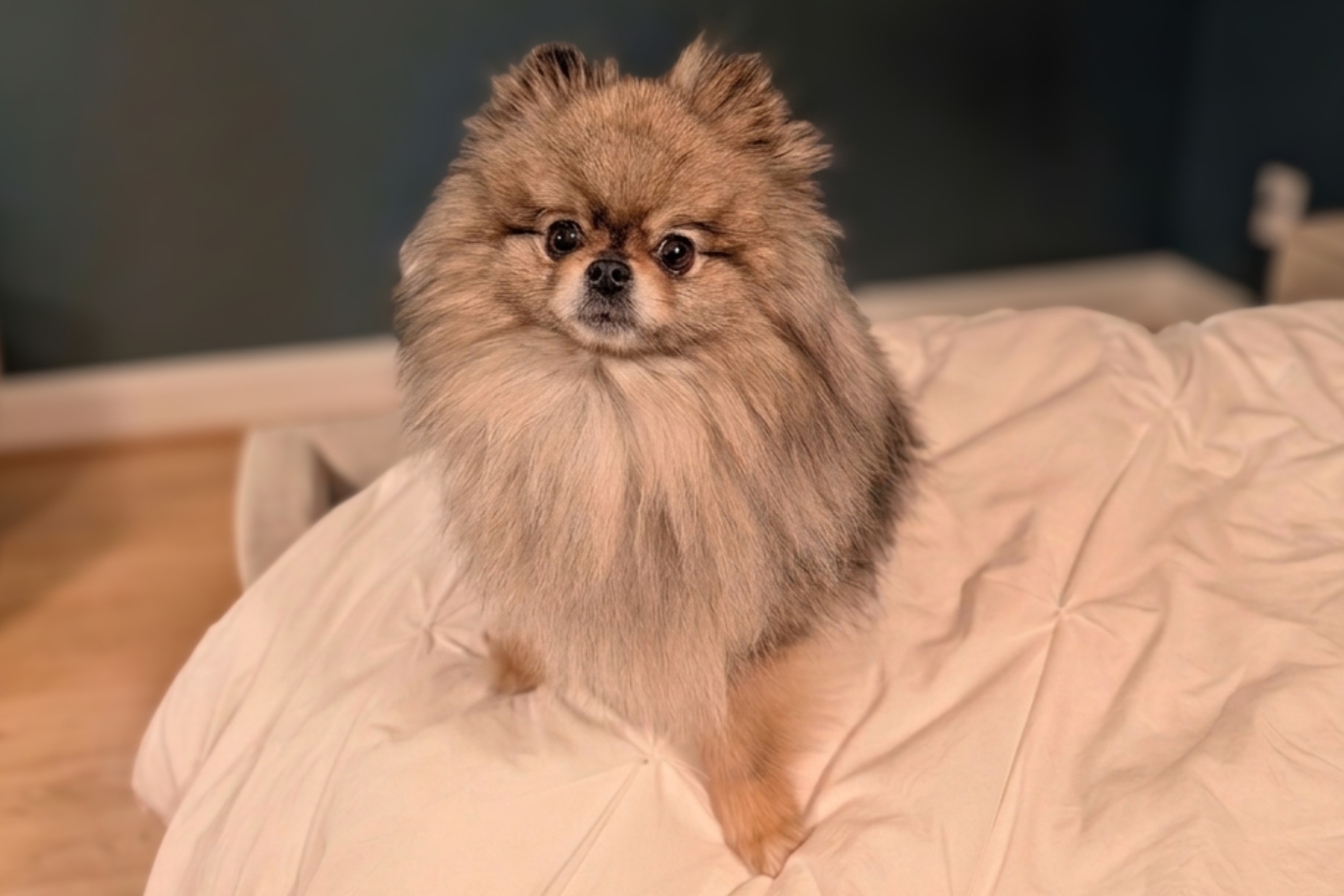
The breed standard describes one coat, but our living room holds three interpretations of it. Beignet, our adult, wears a dense wolf sable coat that’s the textbook version: harsh guard hairs, undercoat so thick you have to part it to find skin. He’s the dog the brushing routine was calibrated on.
Boqui is at the tail end of the puppy uglies, the awkward molt where the puppy fluff drops before the adult double coat comes in. If your young Pom suddenly looks scraggly and thin, that’s the coat being built, not a coat problem.
And Bella, our senior, is a Pomeranian mix. She wears the least Pom-looking coat in the house and she still sheds plenty. She gets the same brush and the same spray as the boys, just in gentler sessions, and she’s the reminder that the routine has to flex with the dog in front of you rather than the breed standard.
Ten years in, the constant isn’t any single coat. It’s that the layer you can’t see is always the one that needs the work.
The routine, end to end
Everything a double coat needs comes down to one principle: keep the undercoat moving. Brush to the skin a few times a week so dead undercoat comes out on a schedule, bathe and force-dry every three to four weeks so it comes out in bulk, and leave the clippers out of it entirely.
If you do one thing after reading, make it this: at your next brushing session, part the coat and brush from the skin out instead of over the top. That single change does more for a double coat than any product on this page, and the step-by-step version is in our line brushing guide.