
Pomeranian Blowing Coat Survival Kit
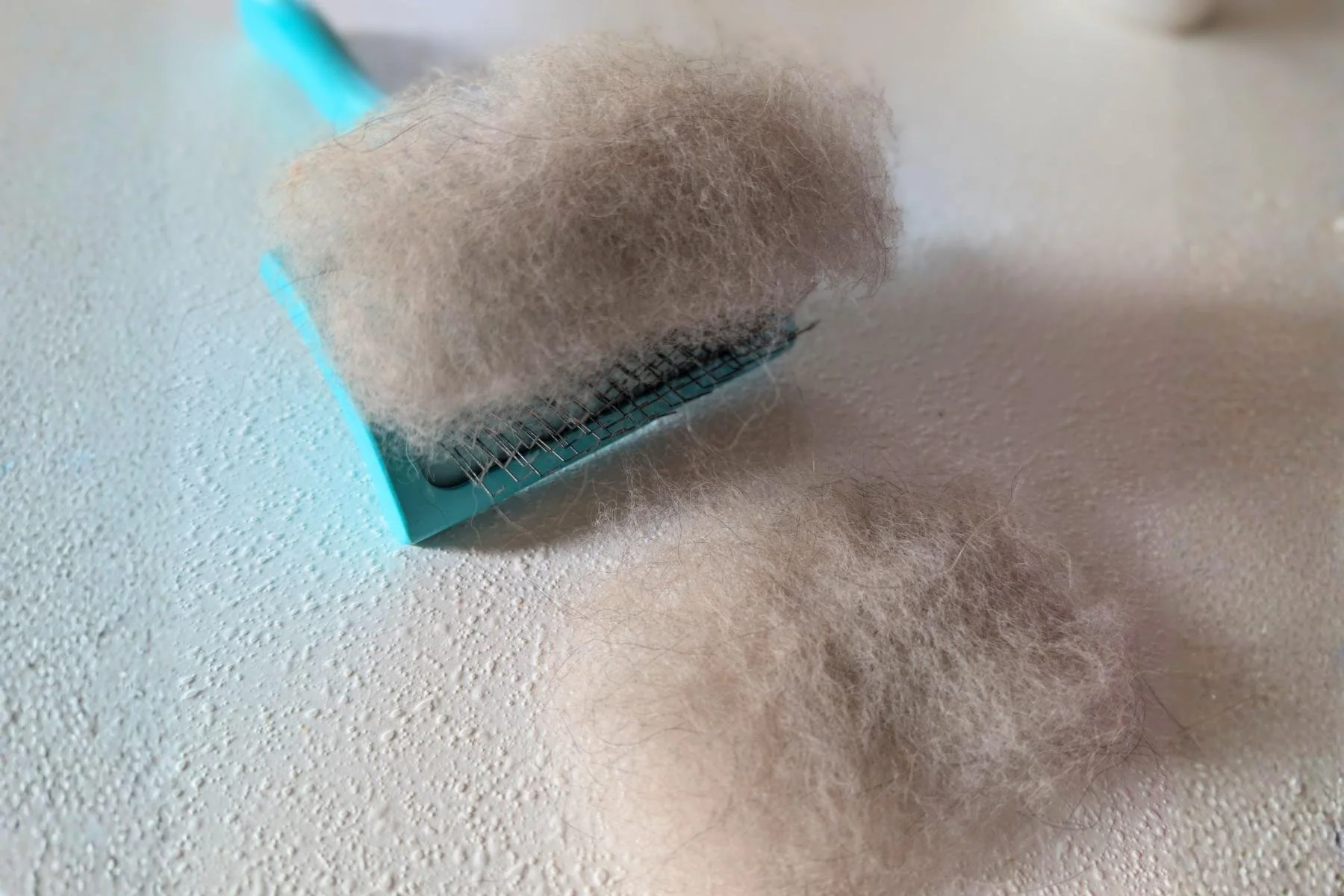
A single daily brushing session during blowing coat season often yields enough undercoat to completely bury your slicker brush.
During Pomeranian blowing coat season, the right kit makes the difference between a manageable few weeks and a fur-covered home. Our complete blowing coat kit comes down to seven things: a long-pin slicker brush, a metal greyhound comb, a detangling spray, an undercoat-loosening shampoo, a high-velocity dryer, a strong vacuum, and an air purifier sized for the room your dog spends the most time in.
If you only buy one thing this season, make it the slicker brush. We use the Chris Christensen Big G Slicker* daily during the worst weeks — it's the single tool that does the most work.
There is a specific moment, twice a year for most Pomeranians, when you walk into a room and find a tumbleweed of undercoat drifting across the floor. You brush, and the brush fills. You brush again ten minutes later, and it fills again. Welcome to blowing coat season.
Beignet blows coat in spring and fall. Bella, at ten, has settled into a more even shed pattern, but still has her moments. Boqui is in the puppy uglies right now, which is a related but different production (more on that here).
Over the years I've tried a lot of products and a lot of strategies. What follows is the kit that earned its place in our house: what we reach for during the worst weeks, what we'd buy again, and a few things we'd skip.
What Blowing Coat Actually Is
A Pomeranian's double coat is built in two layers: a long, weather-resistant guard coat on top and a dense, insulating undercoat underneath. Twice a year, usually spring and fall, the undercoat releases in volume to make room for the next season's growth. That's blowing coat.
It is not the same as everyday shedding. Everyday shedding is a low-grade, year-round release of dead fur. Blowing coat is a coordinated, dramatic event: weeks of fur coming out in clumps, the coat looking patchy or scruffy, and a noticeable change in how your dog's coat sits.
It is also not a problem to be solved. The undercoat is releasing because that's what double coats do. Your job during these weeks is to help the dead fur out of the coat efficiently, and to keep your home from becoming a hair archive in the process. For the deeper science of how the double coat works, see our guide to why you should never shave a Pomeranian.
Blowing coat isn't a problem to fix. It's a process to support, and the right kit makes the support efficient instead of exhausting.
The Seven-Piece Kit
Everything below is something we use during a typical blowing coat cycle. I've kept the list to what actually earns the storage space. There are tools we tried and don't reach for anymore, and I'll mention them where it's useful.
In rough order of how often we use them in a given week:
1. A long-pin slicker brush
This is the workhorse. During blowing coat we use it daily, sometimes twice a day during the worst stretches. The pins need to be long enough to actually reach the undercoat. Most slicker brushes sold for small dogs have pins that only graze the surface of a Pom's coat, which moves fur around without removing it.
We use the Chris Christensen Big G Slicker. It is more expensive than the slickers in the dog aisle at the pet store and it is worth every dollar. The pins are long, flexible at the right tension, and don't snag on Beignet's coat the way cheaper brushes do. We've had ours for years.
If you want the full breakdown of why this brush over a pin brush, and how to actually use it (line brushing, not surface brushing), it's all in our guide to the best brush for a Pomeranian double coat.
2. A metal greyhound comb
The slicker brush moves the volume of dead fur out. The comb tells you what's actually still in there. After every brushing session during blowing coat, I run a metal comb through Beignet's coat to check for what the slicker missed: small mats forming in the armpits, behind the ears, in the chest area where the harness sits.
A greyhound-style metal comb with both wide and fine teeth is what you want. The wide side handles the bulk of the coat; the fine side checks the trouble spots.
Skipping this step during blowing coat is how mats form. The brush handles 90% of the work; the comb catches the 10% that becomes a problem if you ignore it.
3. A detangling spray for the trouble spots
Dry brushing during blowing coat puts stress on the coat. There's enough loose fur that even a careful slicker session can pull on the live coat underneath if you're not careful. A light spray of detangling mist softens the coat enough to let the brush slide through without tugging.
We use the Isle of Dogs Lush Coating spray, a few spritzes before brushing, especially at the chest and behind the ears. It's also what I reach for if the comb finds a small mat that needs to come apart by hand.
If you find a mat the spray and gentle work don't resolve, the full detangling routine is here. The short version: work from the tip of the mat toward the skin, never the reverse, and know when to leave it for the groomer.
4. A shampoo that helps the undercoat release
A bath during blowing coat does more than clean. The right shampoo, paired with a proper rinse, loosens dead undercoat that's still clinging to the coat. It turns a brushing session a day later into a much more productive one.
We use Earth Rated Double Coat Shampoo. It contains jojoba, which softens the dead undercoat enough that it actually wants to come out during the post-bath brush. The critical step most people skip: brushing while the coat is still damp, before it fully dries. The bath loosens the fur; the brush-out while damp is what removes it. Without that step, the loosened fur dries and deposits on your couch over the next week.
Our full bathing approach for the blowing coat weeks is in how often to bathe a Pomeranian.
5. A high-velocity dryer
This is the tool that earns its keep during blowing coat specifically. A high-velocity dryer, the kind that pushes air rather than warming it, is what professional groomers use to literally blow the dead undercoat off the dog. After a bath, ten minutes with the right dryer pulls more dead fur out than an hour of brushing alone.
We have a Shark FlexStyle at home for between-appointment baths. It's not technically a pet dryer, but it is high velocity, has a no-heat and low-heat settings that makes the drying tolerable for Beignet. The coat sits better and we can brush while we blow dry to speed the whole process up.
If you don’t have a high-velocity dryer already, schedule a professional groom at the start of blowing coat season. A skilled groomer with a force dryer can do in twenty minutes what would take you a week of daily brushing at home. That's where most of the cost of a professional Pomeranian groom pays for itself during blowing coat.
6. A vacuum that handles fine undercoat
The dead undercoat that doesn't come out on the brush ends up on your floor, your couch, and a surprising number of surfaces you didn't know were horizontal. A regular vacuum will struggle. Pomeranian undercoat is fine and clings — it doesn't behave like the larger, coarser hair from a shorter-coated breed.
We use the Dyson V15 Detect. It is the single best appliance investment we've made for living with three Pomeranians. The cordless format means I actually pick it up and use it daily during blowing coat instead of dragging out a corded vacuum every other day. The full reasoning and what to look for is in our review of the best vacuum for Pomeranian hair.
7. An air purifier sized for the main room
The fur on the floor is what you see. The dander and the airborne fine fur are what you don't — and during blowing coat, both increase noticeably. An air purifier with a true HEPA filter, sized for the room where your dog spends the most time, makes a measurable difference.
We use a Dyson air purifier in the main living room. The pre-filter catches the visible fur before it reaches the HEPA, which extends filter life. Our experience and why this category matters more during blowing coat is in our guide to the best air purifier for dog dander.
What We'd Skip
A short list of things sold for blowing coat that we either tried and dropped, or never brought into the house in the first place.
Furminator-style deshedding blades. The marketing is built around blowing coat, but the design (a sharp, short-bladed edge that cuts hair as much as it pulls dead fur) can damage the guard coat over time. A long-pin slicker does the same job without the cutting action.
Generic "deshedding" shampoos that aren't formulated for double coats. Most of them strip the coat without actually loosening the undercoat any better than a quality double-coat shampoo would. The category is mostly marketing.
Grooming gloves. Fine for everyday petting and a quick surface refresh, useless during actual blowing coat. The contact area is too small and the bristles too short to reach the layer that's releasing.
How It All Works Together
During the worst two to three weeks of blowing coat, our actual routine looks like this:
Daily brushing with the slicker brush, followed by a comb pass to check for trouble spots.
A bath every two to three weeks, with the double-coat shampoo and a thorough damp brush-out before the coat fully dries.
Force-drying after every bath, either at home or built into a professional groom.
Vacuuming daily (fast pass, not deep clean) to keep the volume manageable.
Air purifier running on a continuous low setting in the main room.
None of this is dramatic. It is repetitive. Blowing coat is not a project you finish; it is a season you get through, and the kit is the thing that turns it from a daily ordeal into a manageable rhythm.
The kit doesn't shorten blowing coat. It makes the weeks bearable: for the dog, the coat, and your house.
Frequently Asked Questions
-
Most blowing coat cycles run two to four weeks at peak intensity, with a tapering period of another two to three weeks before the coat fully resets. Spring blows tend to be more dramatic than fall in our experience, but it varies by dog. Beignet's spring blow is consistently the bigger one.
-
No, and this is the most common mistake new Pom owners make. Shaving a double coat damages the regrowth and can permanently change the coat's texture and ability to regulate temperature. The full reasoning is in our guide to why you should never shave a Pomeranian. Blowing coat is uncomfortable for one to two months a year. Coat damage from shaving is forever.
-
Slightly. We move from a roughly every-three-week bath cadence to every two weeks during the peak of blowing coat, because the bath-and-brush combination releases more dead fur than dry brushing alone. Don't go further than that — over-bathing strips the coat. The full bath frequency reasoning is here.
-
Yes, with appropriate caveats. A true HEPA filter sized for the room captures the airborne dander and fine fur that's circulating, especially during blowing coat. It is not a replacement for vacuuming and brushing — those handle what's already settled. Together they meaningfully reduce the total fur load in the house.
-
Yes, especially if you don't have a high-velocity dryer at home. A skilled groomer with the right equipment can pull more dead undercoat in a single appointment than two weeks of home brushing. We schedule one of Beignet's regular six-week appointments to land at the start of his blowing coat cycle for exactly this reason.
