
The Best Comb for Pomeranian Undercoat (And How to Actually Use It)
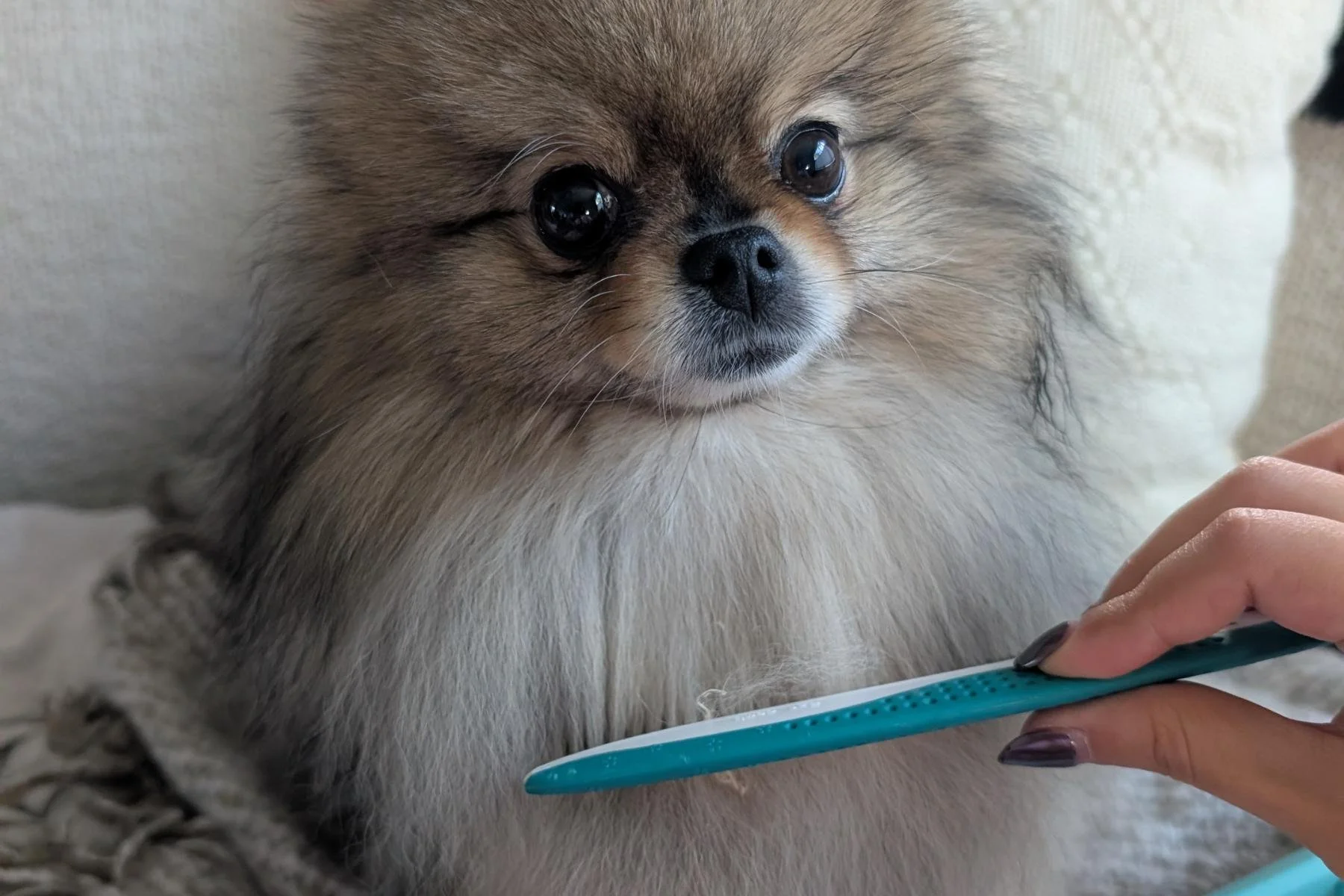
Regular combing keeps your Pomeranian's double coat tangle-free and looking its best
If you've been brushing your Pomeranian regularly and still finding hidden mats when your groomer works through the coat, you're not alone.
It's probably not the brushing. It's the finishing step most people skip.
A slicker brush is essential for line grooming. But the comb is what tells you whether it actually worked.
The right comb for a Pomeranian isn't just a finishing tool. It's your quality check. It reaches through the top coat into the dense undercoat where mats form before you can see them, and it confirms that your brushing session did what it was supposed to do.
Here's what to look for, and the one we keep coming back to.*
Why a Comb Belongs in Every Pomeranian's Grooming Kit
Pomeranians have a double coat: a soft, dense undercoat beneath a longer outer coat. That undercoat is where moisture gets trapped, where mats quietly form near the skin, and where a brush alone often can't reach.
A slicker brush removes loose hair and smooths the surface. But a comb with the right tooth spacing slides down to the skin and detects resistance where none should be. If the comb catches, there's still work to do. If it glides cleanly all the way through, you're done.
Think of the brush as the work, and the comb as the check.
This is especially important in the areas where Pomeranians mat most: behind the ears, under the armpits, along the chest (particularly if your dog wears a harness), and at the base of the tail.
Used consistently at every brushing session, a comb helps you catch the early stages of coat damage before they become a grooming emergency — or a shave.
What to Look for in a Comb for Pomeranian Coat
Stainless steel teeth. Plastic combs flex under pressure and skip over tangles. You need teeth that hold their shape through a dense double coat without bending or dulling over time. Stainless steel is the only material worth using for this.
Rounded tips. Pomeranian skin is more sensitive than it looks. Pointed tips cause micro-scratching that the dog will remember and resist. Rounded ends allow you to work close to the skin without discomfort.
Dual tooth spacing. One side with wider spacing for the undercoat and initial detangling, one side with narrower spacing for finishing and checking finer areas around the face and ears. A dual-sided comb means one tool handles the full session.
A non-slip handle. Grooming a Pomeranian requires control. A handle that slips or causes hand fatigue mid-session leads to rushed work, and that's when you miss things.
Lightweight and compact. This tool is used at close range, with precision. A heavy comb is tiring to maneuver around ears, collar lines, and the underbelly. You want something that feels like an extension of your hand.
The Comb We Recommend
After testing a number of options, we keep coming back to the SUKETIL stainless steel grooming comb. Unlike our slicker brush recommendation, it’s not particularly fancy, but it hits every mark: stainless steel teeth, rounded tips, dual tooth spacing, and a non-slip handle.
Beignet-approved. This one lives on the grooming shelf alongside the slicker brush. It's part of the routine, not an occasional accessory.
How to Use It in Your Grooming Routine
The comb is most effective as the final step after line brushing, not a replacement for it. Here's how it fits into a complete session:
Mist the coat lightly with a conditioning spray before you begin. Never brush or comb a completely dry Pomeranian coat. It increases breakage.
Work through the coat section by section with your slicker brush, lifting the coat from the skin upward as you go. This is line brushing, and if it's new to you, it's worth reading before your next session.
Once brushed, follow each section with the wide-toothed side of the comb, moving from skin to tip. Any resistance means go back to the brush.
Finish high-risk areas, including behind the ears, the chest, and under the armpits, with the narrow-toothed side. These are where mats form first and are hardest to spot.
The whole comb-check step adds two to three minutes to your session. It's the difference between a coat that looks brushed and a coat that actually is.
Where It Fits in the Full Grooming Kit
The comb works as part of a system, not in isolation. If you're building out your Pomeranian grooming kit, here's how the pieces connect:
The slicker brush does the primary work, removing loose hair, smoothing the coat, and working through tangles section by section.
The conditioning mist prepares the coat before you touch it, reducing breakage and making both tools more effective.
The comb confirms the work is done and catches what the brush can't reach.
All three are covered in our Pomeranian grooming tools guide if you want the full picture, and on The Favorites if you just want the links.
The Short Version
A comb is not optional for a Pomeranian with a healthy double coat. It's the step that makes brushing count.
The SUKETIL stainless steel comb is the one we use because it's built for the job: stainless teeth, rounded tips, dual spacing, and a handle that doesn't fight you. Simple criteria. Consistent results.
Add it to your kit once and it'll last for years.
